
Poughkeepsie Resident Lookup Records
A Poughkeepsie resident lookup works best when you begin with one solid fact. A dated address, a case number, a year, or a license can each open a different door. Poughkeepsie keeps its records with different custodians. Each custodian answers a different question about a resident. Match the record to what you actually want to know. That discipline prevents dead ends. It also keeps you from confusing two Poughkeepsie residents who share a name. It keeps you from mistaking an access limit for a missing record. You can find who lives on a street in Poughkeepsie, trace past residents, or confirm a parcel owner. But the source you choose shapes the answer you get.
| Record | What It Confirms | Where | Access |
|---|---|---|---|
| Parcel and assessment record | Parcel identity, owner, and owner mailing address | City Assessor or ParcelAccess | Official public-record route |
| Public court index | Public case or docket existence | WebCivil Local and the court clerk | Online index and courthouse access, subject to restrictions |
| Voter confirmation | A voter’s own registration and polling information | New York voter lookup | Private confirmation, not an open resident list |
| Genealogy record | An eligible historical vital relationship | City Vital Statistics or NYS DOH genealogy | Age, relationship, proof, and fee rules apply |
| License or entity filing | A license or registered-entity relationship | NYS DOS license search | Public search, but not residence proof |
Start with an address when you need parcel identity. Start with a year when the question is historical. Reach for a court or license index only after you know the record type. The DOS license search takes last name, first name, license type, county, city, and ZIP, and it can confirm a license relationship or status. It will not return a home address. A Poughkeepsie resident lookup earns trust when it says plainly what the underlying record can and cannot establish.
Poughkeepsie Resident Name Checks
False matches happen easily in Poughkeepsie. A common surname, initials, spelling drift, married names, and repeated street numbers can all point to the wrong person. Anchor the name to at least one independent fact. Use an address, an approximate year, a parcel, an occupation in a dated directory, or a party role in a case. Write down the source date as well. That small habit separates an indexed fact from a guess about a Poughkeepsie resident.
ParcelAccess breaks out parcel location, municipality, owner, and primary owner mailing address. Those fields help you tell similarly named people apart. They do not name an occupant, though. When an address is your true starting point, the street-by-street method belongs in the Poughkeepsie street directory. Come back to a name search only after the municipality and address check out.
Note: City of Poughkeepsie and Town of Poughkeepsie are separate parcel jurisdictions, so pick the right municipality before trusting a similar-sounding location.
Poughkeepsie Resident Lookup Court Checks
WebCivil Local searches past, present, and future local civil cases across local courts. Party search gives you a name route. An index-number route is also available. The form narrows results by court, case type, year, status, and role. For a Poughkeepsie resident lookup, it answers whether a public local civil case exists. It does not promise that every court record is online.
| Observed control | Available choice or mode |
|---|---|
| Index | Case type, number, year, and court code |
| Party | Name search |
| Attorney and judge | Search controls |
| Role | Plaintiff, Defendant, or Either |
| Court(s), case type, and year | Filters, including multiple court selection |
| Status and future appearances | Open or All, plus appearance option |
| Sort and output | Sort control with HTML or PDF |
The official WebCivil Local search is the source for the screen shown here.
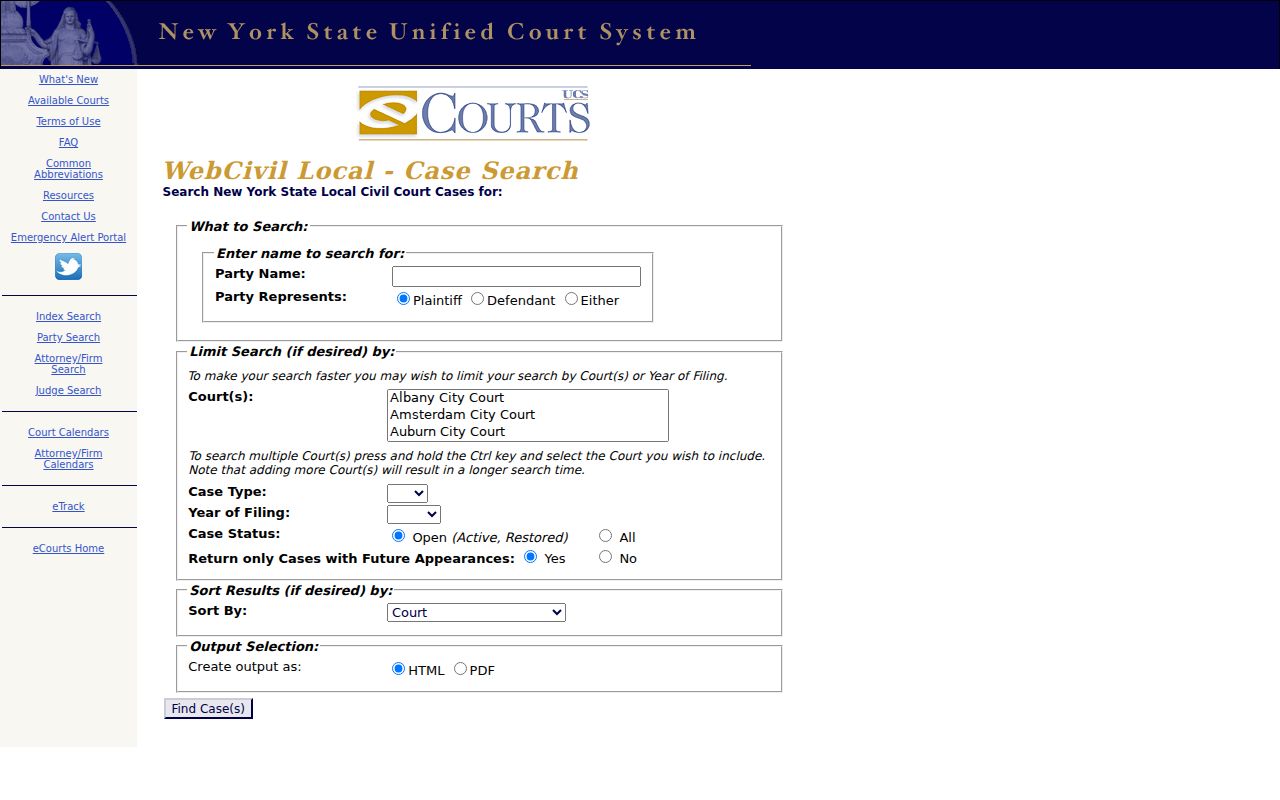
The search controls and case-identifier options describe what the system offers. They are not a full result set. Assume nothing about result columns, address displays, or an exact historical start date. WebCivil Local also warns that sealed and restricted matters can be omitted. No result, in other words, is not proof that no case exists.
An index number accepts a fuller form such as CV-000044-06/AU. A shorter one such as 44-06 works too. Multiple courts can be selected with Ctrl. Treat these as navigation aids rather than a guarantee of a complete court file. Criminal, family, surrogate, Supreme, and federal matters each have their own application. Use the one matching that court and record type. WebFamily, for instance, requires a court and file or docket number. It skips the ordinary name search.
WebCivil Supreme handles Supreme Court matters. It carries its own index, name, attorney, justice, role, court, year, and status controls. WebCriminal works from a case identifier, defendant, or court calendar and notes update delays. WebSurrogate allows party or name searches. Date-of-death and file-number paths are also open, though not all files are online. eTrack needs a free account. It tracks active available cases rather than serving as a general name index. Federal matters go through the Southern District of New York PACER route.
Poughkeepsie Resident Voter Limits
New York's voter lookup form asks a searcher for county, last name, first name, date of birth, and ZIP code. The service is billed as a registered voter's confirmation route. It also needs cookies and JavaScript to work. Because its result screen does not render unattended, treat it as a confirmation tool rather than an open name directory for a Poughkeepsie residents directory effort or a way to establish a household.
Dutchess County voter material sits with the Board of Elections, at 112 Delafield Street in Poughkeepsie. Normal office hours run Monday through Friday, 9 to 5, with a seasonal summer-hours notice worth checking before a visit. A voter-data request routed to the state must state an elections purpose under Election Law §3-103(5); the county records-access officer can explain the fields, format, fee, date, and permitted use. Confidential registrations under Election Law §5-508 stay segregated from ordinary access.
Send county-held material to the county office. Statewide or multi-district material follows the New York State Board of Elections request route. A request should pin down a date, area, and field set instead of chasing every record attached to one name in a resident lookup.
Poughkeepsie Resident Vital Eligibility
The City genealogy request form covers City of Poughkeepsie records only, back to 1881. From 1881 through 1923, access runs under the genealogy rule. Records from 1923 forward need proof of relationship plus death or other eligibility evidence. The city allows up to eight weeks of processing. It charges a non-refundable $22 search fee covering a one-to-three-year search, with a no-record certification included. Longer spans carry separate fee tiers.
New York State applies different thresholds for genealogy. Birth records open after 75 years when the person is known deceased. Death records open after 50 years. Marriage records open after 50 years when both spouses are known deceased. The state genealogy fee is $22. That covers an index search of up to three years on microfilm plus a copy or a no-record statement. A recent certified copy follows separate eligibility and identification rules. The official Adoption Information Registry is its own route for New York-born or adopted people. It is not a casual name-search tool in any Poughkeepsie residents directory sense.
A city walk-in request needs legal photo identification. A mail request needs a notarized letter and a stamped self-addressed envelope or prepaid postage. Payment must come by city money order, bank-certified check, or credit card. Personal checks and cash are not accepted. Pick the custodian holding the event before paying. The state and city routes use separate forms and eligibility rules.
Verify a Poughkeepsie Resident
Verification works best as a trail, not a single hit. Compare independent records across the Poughkeepsie residents directory and its related rolls, and never let an owner field or an index entry become a claim of current residence in a resident lookup.
- Write down the full name and one independent check, such as a confirmed address, approximate year, or court party role.
- Use the City Assessor or ParcelAccess for parcel identity, and treat the owner and mailing address as ownership information only.
- Choose the matching route: a city directory for a dated listing, a parcel or deed record for ownership, WebCivil Local for a local civil case, or a vital custodian for an eligible relationship record.
- Compare dates and name variants. Ask the clerk or custodian for an authorized copy only when the record and eligibility rules support the request.
- Docket
- A court’s running file of a case and its recorded events. A docket entry shows case activity, not a conclusion about a person.
- Index vs image
- An index helps locate a record by fields such as name or number. An image is the underlying filed or scanned document, which may have different access rules.
- Certified copy
- A custodian-issued copy authenticated for an authorized use. It is different from a search result or an ordinary reference copy.
Poughkeepsie Resident FOIL Route
When a city agency holds a defined record that is not online, file a narrow request through the City of Poughkeepsie FOIL route. New York Public Officers Law §§84-90 presumes access. But it allows exemptions for privacy, security, law-enforcement matters, and other protected interests. Name the agency, record type, date range, and preferred format. Do not ask for a broad person file.
The statewide guide calls for a grant, denial, or acknowledgement within five business days. It also sets an approximate completion date and a 30-day appeal route. Paper copies generally run $0.25 per page, and an electronic format should be used where reasonable. Court case files follow court access rules and clerk instructions instead of ordinary municipal FOIL.
A focused request can seek a described document, a defined address or parcel, and a short date range. It should not demand sensitive identity fields. It should not ask an agency to assemble a new profile on a person. If an agency denies access, keep the request and response for the statutory appeal. Material belonging to Dutchess County, a state office, or a court goes to that actual custodian, not the City.
Poughkeepsie Resident Lookup Privacy Limits
Public access has firm boundaries. New York's Address Confidentiality Program under Executive Law §108 gives qualifying victims and household members a substitute address with mail forwarding. State and local agencies must use that substitute in their records. Never try to derive or reveal the actual location behind it. Confidential voter records, sealed court files, and restricted vital material can also be correctly absent. A Poughkeepsie residents directory search may show none of it.
Keep only the fields needed to verify a record. Cite the agency and date. Take any correction or protection request to the original custodian. A Poughkeepsie resident lookup should not carry signatures or sensitive identity details. It should also exclude protected addresses, or an inferred household relationship.
For corrections, preserve the source URL and retrieval date. Then contact the originating agency. Use the ACP or confidential-voter process for safety-related records. A court clerk handles a restricted court file. The FOIL appeal route covers an agency denial. A lawful research trail names the custodian, and still leaves protected details protected.
Lawful personal use. Use public records for a legitimate personal research purpose. Never use a result to stalk, harass, intimidate, or harm anyone.