
Map Poughkeepsie City Directory Runs
Poughkeepsie city directory material is spread across a library project, local shelves, a genealogy guide, and subscription or in-library databases. The available runs overlap but are not identical. Start by identifying the year and collection, then check whether the result is a digitized page, a print volume, or a database index. PPLD’s project is scanning Poughkeepsie directories from 1846 to the present as the collection permits, while other institutions describe broader printed or selected runs.
| Collection | Years | Where Held | Access |
|---|---|---|---|
| PPLD digitized city-directory project | 1846-present, scanning as collection permits | PPLD Main and Market digital collection | Free digitized search; year-by-year completeness varies |
| PPLD library city-directory run | 1846-1918; 1920-1924; 1926-1937; 1939-1943; 1946-1953; 1955-1961; 1965-1976; 1983-2005 | Adriance Memorial Library Local History Room | Non-circulating local collection; call before visiting |
| NYG&B printed Poughkeepsie directories | 1843-1992 | NYG&B Dutchess County guide and local research collections | Guide to the run; confirm the volume and access point |
| Selected Ancestry directory titles | 1890, 1891, 1893, 1895, 1896, 1897 | Ancestry Library Edition and its established genealogy collection | Selected database volumes, including in-library access at PPLD |
Publication gaps matter. A missing year can mean that the library lacks a volume, the scanning project has not reached it, or a database does not include it. It does not prove a person disappeared from Poughkeepsie. Record the publication year, publisher, volume page, and collection name before moving to the next source.
Search Poughkeepsie Directory Scans
PPLD launched its digitized Poughkeepsie city-directory collection in 2021. Its online portal is a practical first pass because it brings searchable directory material together without replacing the physical Local History Room. The library describes the project as continuing from 1846 forward as volumes become available. Search results should be checked against the page image, especially where an old typeface, abbreviated name, or street label affects the reading.
PPLD’s city-directory collection overview identifies the Poughkeepsie runs, publishers, and the digitization effort.
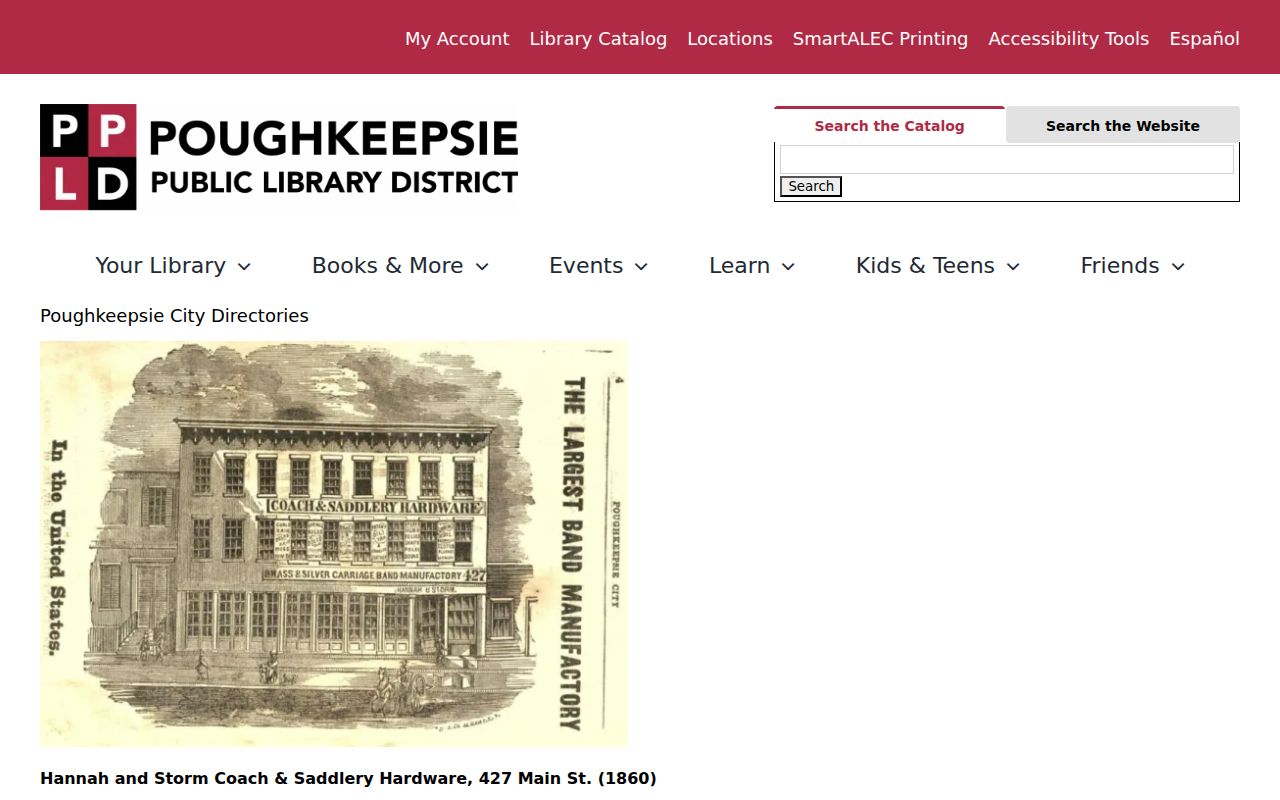
The collection overview is the best place to compare a wanted year with the named Poughkeepsie directory series before searching a volume.
The Main and Market digitized directory search is the direct portal for the scanned Poughkeepsie material.
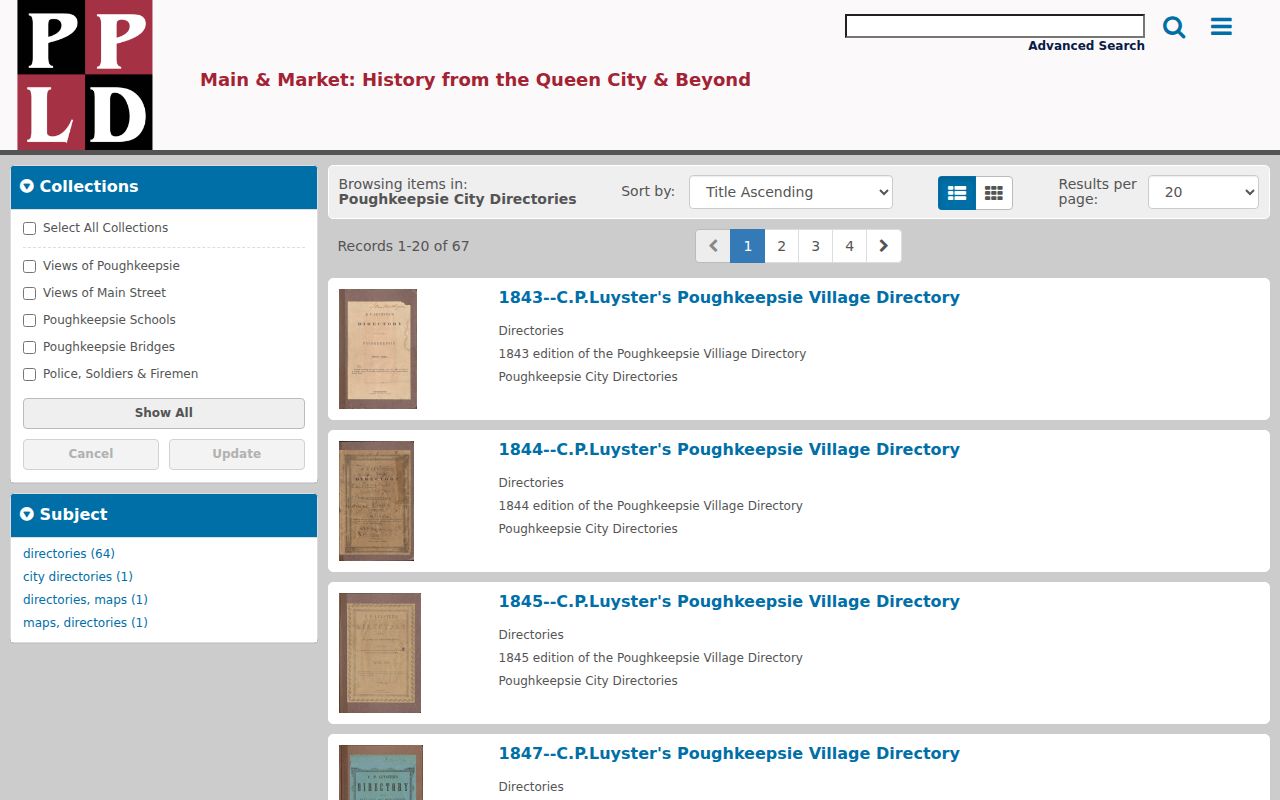
Use the digitized search as a lead, then retain the year and original page details with the result.
Follow Poughkeepsie Directory Publishers
The named publisher helps place an entry in the city’s history. PPLD identifies Underhill’s City of Poughkeepsie Directory for 1855, David B. Lent Jr.’s 1860 directory, John P.A. Vail’s 1872 directory, R.V. LeRay’s 1881 directory with additional digitized 1890s volumes, and John Bradley’s 1906 House Directory of the City of Poughkeepsie. These are not interchangeable labels. Each volume is a separate annual or period snapshot with its own coverage and arrangement.
The library’s examples show businesses and residents alongside streets and occupations. The 1860 material includes examples on Main Street, while the 1872 material includes an example on South Water Street. Those examples demonstrate how a city directory can pair a person or business with a street in a given year. They do not establish a complete household roster or any present connection to that address.
| 1855 | Underhill’s City of Poughkeepsie Directory |
|---|---|
| 1860 | Lent’s Poughkeepsie City Directory |
| 1872 | Vail’s Poughkeepsie City Directory |
| 1881 and 1890s | R.V. LeRay’s Poughkeepsie City Directory |
| 1906 | John Bradley’s House Directory of the City of Poughkeepsie |
Note: A publisher and date identify a directory’s context, but only the page itself shows the exact fields and abbreviations used in that volume.
Read Poughkeepsie City Directory Entries
A Poughkeepsie city directory entry should be transcribed as an inventory, not expanded with guessed details. The observed 1860 examples support only name or business, street number and street, and occupation or business category. A page might be organized around an individual, a business, or a street. If a mark or abbreviation is unclear, preserve it exactly, record the page, and seek the key from the same volume rather than assigning a meaning from another directory.
| Name or business | The listed person, firm, store, office, or other named entry as printed. |
|---|---|
| Street number and street | The dated address wording, useful for comparing the same location in maps and later sources. |
| Occupation or business category | The activity or category associated with that listing in the observed directory material. |
- Criss-cross directory
- A directory arranged by street or address, useful for tracing a location in a stated year.
- Householder index
- An index that groups a directory’s household-oriented entries when that volume supplies one.
- Abbreviation key
- The volume’s own explanation of shortened terms and symbols. A complete Poughkeepsie key was not captured in the research, so unverified marks should not be expanded.
A name or business entry is neither a deed nor a parcel card. It gives a dated listing that should be matched with an independent address, year, or record role before drawing a historical conclusion.
Visit Poughkeepsie Directory Collections
Adriance Memorial Library’s Local History Room at 93 Market Street is Poughkeepsie’s central local-history access point. It holds Poughkeepsie, Dutchess County, and Mid-Hudson maps, correspondence, civic and fraternal records, histories, local government material, and school collections from the late 1700s onward. The library says these materials are non-circulating and sometimes restricted. The room is not staffed every library hour, so call before a visit.
PPLD also provides in-library Ancestry Library Edition, remote HeritageQuest for cardholders, historical newspapers, New York Heritage, NY Historic Newspapers, NOVELny, and reference resources. Licensed databases can impose card, in-library, or provider access limits. For a narrow question, search the digitized collection and catalog first, then ask the Local History Room or Poughkeepsie municipal historian which volume, map, or database best fits the year.
PPLD’s Local History Room information explains the non-circulating collection and its research scope.
The Dutchess County Historical Society offers finding aids, maps, deed collections, institutional papers, and local-history research services. Its current appointment and reproduction schedule was not located, so contact the society before relying on an in-person research plan.
Trace Poughkeepsie City Directory Households
Use a city directory as one point in a dated chain. Start with the earliest confirmed spelling, then compare the next available directory year rather than assuming every annual volume exists. Record the street number, street wording, and occupation or business category exactly as printed. A move, a changed street label, or an omitted entry is a question to test, not an answer by itself.
- Locate the first verified name or business entry and save its publication year and page.
- Follow the same spelling, address, or street through the next available Poughkeepsie city directory volume.
- Pair the address with the appropriate census schedules: 1790-1880, then 1900-1950. The 1890 population schedules were largely destroyed.
- Use a County Clerk deed or assessment record to test ownership, keeping owner, grantor, grantee, and directory listing as separate roles.
- Compare the address with a Sanborn sheet or DCHS map when the question is about the block or building rather than a person.
Directories and censuses complement each other. The directory can offer closer year-to-year address context, while census schedules provide an enumeration snapshot. Newspapers, tax rolls, deeds, and local finding aids can help explain a gap, but absence from one source is not proof of death, departure, or identity.
Map Poughkeepsie Directory Addresses
The strongest address-based follow-up is a map, not an assumption about a present occupant. DCHS lists Poughkeepsie maps from 1780, 1798, 1799, 1834, 1837, 1858, 1874, 1876 North and South, Sanborn 1887, 1891, and 1929. The Library of Congress provides a 1913 edition republished in 1950 with 100 sheets. These sources can show street and block layout, building footprints, uses, materials, heights, house numbers, and boundaries.
The Library of Congress Poughkeepsie Sanborn record is a route to the 1913 and 1950 map material. Compare the map date with the city directory year and any numbering change before matching an address. The city’s numbering ordinance traces to 1929, and its official map dates to 1955, so a modern street number cannot simply be projected backward without checking the period source.
For a current parcel crosswalk after the historical work is complete, use the address-focused Poughkeepsie Street Directory. ParcelAccess and current rolls belong to that modern address route; the historical collections remain the source for dated directory evidence.
Date Poughkeepsie Directory Collections
The collection chronology helps select the right shelf before a name search begins. It also shows why a directory gap needs a second source rather than a broad conclusion. The library project, publisher titles, printed run, and later holdings each describe a different part of the Poughkeepsie city-directory record.
- 1843: NYG&B reports the beginning of the printed Poughkeepsie directory run.
- 1846: PPLD’s scanning project begins its collection coverage.
- 1855-1906: Underhill, Lent, Vail, LeRay, and Bradley volumes provide named publisher checkpoints.
- 1992: NYG&B reports the end of its printed run.
- 2005: the listed PPLD library run reaches this year, with gaps between its available periods.
- 2021: PPLD launched the digitized Poughkeepsie city-directory collection.
The time line distinguishes collection availability from any claim about a person. A page image and its publication year remain the evidence to cite.
Keep Poughkeepsie Directory Evidence Dated
City directories are valuable because they preserve a local snapshot, but their limits are just as important. The PPLD scan project is ongoing, digitized coverage and printed coverage do not perfectly match, and the complete abbreviation key for the observed page was not captured. A business listing does not prove a home address. A directory listing does not replace a deed, a census, or a modern parcel record. Preserve the source and year before combining it with another record.
When a record is not online, the fallback sequence is clear: ask PPLD about the Local History Room holdings, check its catalog and digitized collection, then contact DCHS or the County Historian about a finding aid or map for the period. Copyright and database licensing can limit downloads even when a library can provide in-person access. A careful Poughkeepsie city directory search respects both the collection’s access rules and the difference between a historical listing and current identity.